

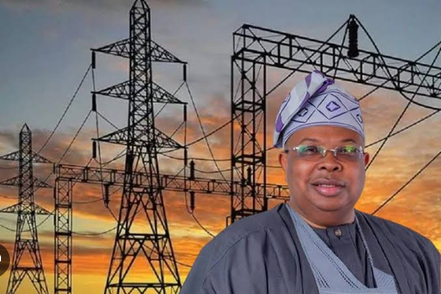
Tegbe Promises Better Power Supply Within 72 Hours
The Power Minister blames Egbin maintenance, gas shortages and transmission constraints for prolonged blackouts, as TCN disputes Ikeja Electric’s explanation for recent outages
Nigeria’s Minister of Power, Joseph Olasunkanmi Tegbe, has promised an improvement in electricity supply within 48 to 72 hours as the Federal Government moves to address generation shortages, gas supply constraints and transmission problems responsible for prolonged blackouts across parts of the country.
Also read: VIDEO: Kate Henshaw Slams Nigeria’s Poor Power Supply in 2026
Tegbe gave the assurance on Friday, November 6, 2026, amid growing complaints from electricity consumers in Lagos, Ogun, Abuja and other affected areas, where households and businesses have experienced reduced hours of power supply.
In a statement titled ‘Update on Power Situation’, published on his Facebook page, the minister attributed the latest disruptions partly to planned maintenance at Egbin Power Station in Lagos State, alongside inadequate gas supplies to some thermal generating plants.
Egbin Power Station, located in Ijede, Ikorodu, is Nigeria’s largest thermal electricity generating facility, with an installed capacity of 1,320 megawatts across six generating units.
The plant contributes more than 16 per cent of electricity generated for the national grid, making its operational availability particularly important to the country’s power supply.
Tegbe acknowledged the difficulties experienced by electricity consumers and said the government understood the pressure the outages had placed on households and businesses.
“I am aware of the strain that the current outages have placed on households and businesses in four affected states, including Lagos and the Federal Capital Territory,” he said.
He explained that the maintenance activities and gas supply constraints had reduced the volume of electricity available for distribution, forcing grid operators to introduce load shedding in some locations to manage the shortfall.
The minister also identified damage to critical transmission lines, allegedly resulting from sabotage, as another factor limiting the ability to use alternative routes to supply electricity to some areas, particularly Lagos.
He said the Ministry of Power was working with relevant operators to restore affected generating units in phases, improve gas availability and accelerate repairs to damaged infrastructure.
“My team and I are working to return the affected generating units to service in phases, with the first units coming back online within the next 48 to 72 hours.
“We are also working with operators to improve gas supply and accelerate repairs to the damaged infrastructure,” Tegbe added.
However, the minister’s timeline relates to the return of the first affected generating units, rather than a guarantee that electricity supply will be fully restored to all affected communities within three days.
The assurance follows an earlier intervention by the minister, who directed the Transmission Company of Nigeria (TCN), Nigerian Independent System Operator (NISO) and electricity distribution companies to address operational challenges affecting generation and supply.
In a statement issued on Thursday, November 5, the Ministry of Power said preliminary assessments indicated that the disruptions were not caused by a major or systemic failure of the national grid.
Instead, it identified maintenance and operational difficulties across parts of the electricity value chain, gas supply constraints affecting thermal power stations and reduced output from hydroelectric plants due to lower water inflows into reservoirs.
The ministry listed Lagos, Abuja, Ogun, Kwara and Oyo among the areas experiencing reduced electricity supply.
Meanwhile, the worsening electricity situation has triggered a disagreement between TCN and Ikeja Electric over the causes of recent outages affecting customers in parts of Lagos.
The dispute followed an Ikeja Electric public notice issued on November 5, attributing several interruptions recorded on November 3 and 4 on some Band A feeders to grid instability and identifying TCN as responsible.
Ikeja Electric had earlier apologised to customers on affected Band A feeders for failing to meet the minimum daily electricity supply requirement of 20 hours on November 3 and 4.
However, TCN rejected the distribution company’s explanation, describing its attribution of the outages to grid instability as inaccurate and misleading.
In a statement on Friday, the transmission company argued that determining the causes of disturbances and interruptions on the national grid falls within the statutory responsibilities of NISO under Section 67 of the Electricity Act 2023.
TCN maintained that NISO had not identified any failure of its transmission network as the cause of the outages highlighted by Ikeja Electric.
The company instead pointed to inadequate gas supplies to thermal power stations and reduced hydroelectric generation caused by lower reservoir inflows as the principal factors behind the decline in available electricity.
“TCN can only transmit the energy made available to it and cannot transmit energy that is not generated,” the transmission company said.
To support its position, TCN presented figures from its operational records covering interruptions across feeders supplying Ikeja Electric on November 1 and 2.
According to the company, 68 per cent of the interruptions resulted from frequency-control load shedding caused by inadequate electricity generation.
It attributed another 26 per cent to Ikeja Electric’s alleged failure to comply with load allocations issued by NISO’s National Control Centre, alongside faults and maintenance work on the distribution company’s network.
The remaining six per cent, according to TCN, resulted from its planned maintenance, switching operations or transmission line limitations.
The transmission company also examined 46 interruptions recorded on the 33kV feeders identified in Ikeja Electric’s notice.
It said 29 resulted from load shedding arising from low generation, while 14 were attributed to Ikeja Electric, comprising nine cases of non-compliance with load allocations and five faults or trips on its distribution network.
The remaining three interruptions were linked to scheduled TCN maintenance on the Ogba-Alimosho transmission line on November 1.
The disagreement has added another dimension to consumers’ concerns about accountability within Nigeria’s electricity supply chain, particularly as households and businesses continue to bear the cost of unreliable power.
For many residents in Lagos and Ogun, the prolonged outages have also coincided with hot weather conditions, increasing reliance on generators and adding to the cost of running homes and businesses.
Beyond the immediate restoration efforts, the latest disruptions have again highlighted the interconnected challenges facing Nigeria’s electricity industry, from gas availability and generating capacity to transmission infrastructure and distribution network management.
Although Tegbe’s 48-to-72-hour assurance offers a timeline for the return of the first affected generating units, the extent to which consumers will experience sustained improvements will depend on the successful resolution of the wider operational constraints.
Also read: Lagos Targets 24-Hour Power Supply Through Energy Summit
The Federal Government is expected to continue working with generation companies, TCN, NISO and distribution companies to restore supply and prevent further disruptions.



