

Obasanjo Reveals Why He Rejected US Asylum Under Abacha
The former president says he returned to Nigeria despite a warning from the American ambassador, only to be arrested, convicted over an alleged coup plot and sentenced to 15 years in prison
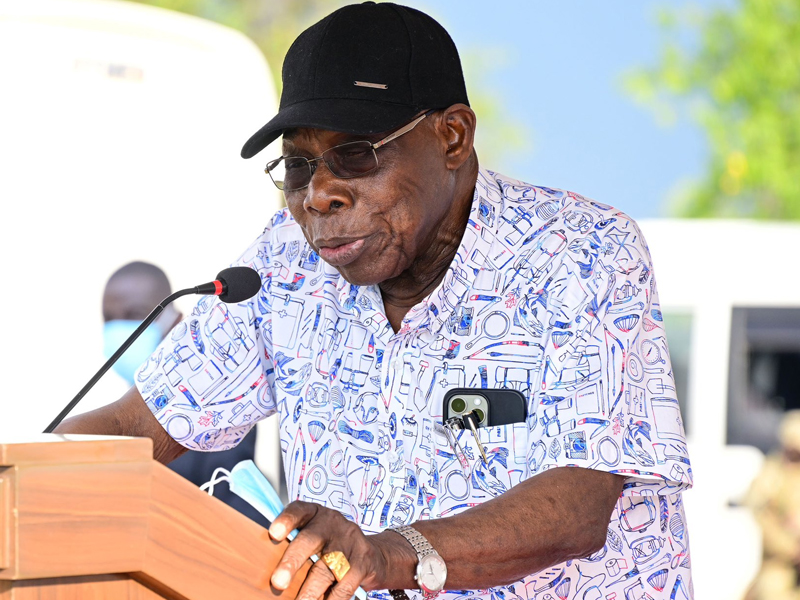
Former Nigerian President Olusegun Obasanjo has recounted how he rejected an offer of political asylum from the United States, returned to Nigeria despite a warning that he could be arrested, and was subsequently imprisoned under the military regime of the late General Sani Abacha.
Also read: Obasanjo Slams Tinubu’s Debt Defence, Warns of Generational Burden
Obasanjo shared the account in a video published by BBC News Pidgin on Tuesday, November 10, 2026, while reflecting on his transition from military service to farming and the events that led to his detention during one of Nigeria’s most turbulent political periods.
The former president said he ventured into agriculture after retiring from the Nigerian Army at the age of 42, having attained the rank of a four-star general and served as the country’s military Head of State.
Obasanjo assumed leadership on February 13, 1976, following the assassination of General Murtala Muhammed. He remained in office until October 1, 1979, when he handed over power to the civilian administration of President Shehu Shagari.
Explaining his decision to leave the military, Obasanjo said he felt he had reached the highest position available to him in the armed forces and had little reason to continue his military career.
“When I was leaving government as military Head of State, I was leaving too early. I didn’t join the army to retire at the age of 42,” he said.
He added that farming became his next ambition, and the venture was progressing well before his arrest years later.
“So what can I do? I decided I would go into farming. It really was going well, and it went well until I was arrested,” he said.
His account then turned to the period under Abacha, who took power on November 17, 1993, and ruled until his death on June 8, 1998.
Obasanjo said he was travelling abroad when the American ambassador in Nigeria contacted him and disclosed that the US government had offered him political asylum because it believed he would be arrested if he returned home.
Despite the warning, the former president said he rejected the offer because he did not believe he had committed any offence that justified seeking refuge outside Nigeria.
“This was difficult for me. I haven’t done anything. What do they want to arrest me for? I don’t want political asylum,” he recalled.
According to Obasanjo, he returned to Nigeria and proceeded to his farm, where one of his security personnel informed him that government security operatives had surrounded the property.
He said a police officer dressed in civilian clothes subsequently approached him, claiming that an Assistant Inspector-General of Police wanted him to report to the station.
Obasanjo said he questioned the manner in which the invitation was delivered and insisted that the senior police officer should come personally if he wanted to see him.
Rather than wait for the police to take him away, he drove himself to the station, where the Assistant Inspector-General informed him that he had been instructed to arrest him.
The former president also recalled the intervention of former United States President Jimmy Carter, who appealed to Abacha on his behalf.
Obasanjo said Carter’s intervention initially led to his transfer from an undisclosed detention facility to house arrest at his farm.
However, he said the reprieve did not last. According to his account, security agents arrived at about 1am on a night when he was playing squash and took him away to prison.
“I didn’t know that it was a decision of Abacha that some of us must not be kept free; otherwise, he would feel unsafe. I was put in a place.
“Then President Jimmy Carter came. He pleaded, and then they put me under house arrest.
Then they came one day; I was playing squash at about 1am. They came and said they were taking me away. And they took me away, and from there, I went to prison,” he said.
Obasanjo’s account is consistent with historical records documenting his arrest in March 1995 over an alleged coup plot against Abacha’s government.
Human Rights Watch reported that Obasanjo was among 43 people tried by a military tribunal in secret proceedings in June and July 1995.
The organisation raised concerns about the fairness of the trial, including restrictions on defendants’ choice of legal representation and the absence of an appeal process.
Amnesty International also questioned the basis of the convictions, describing the proceedings as unfair and expressing concern that allegations of coup plotting had been used to imprison prominent critics of the military government.
Obasanjo was initially sentenced to life imprisonment, but the sentence was commuted to 15 years following international appeals.
His former deputy, Major-General Shehu Musa Yar’Adua, was also convicted in the case and sentenced to 25 years after his death sentence was commuted.
Carter’s intervention in Obasanjo’s detention was also publicly acknowledged by the former president in January 2025, when he paid tribute to the late American leader.
Obasanjo said Carter had visited Nigeria and persuaded Abacha to move him from detention to house arrest at his farm.
Obasanjo regained his freedom following Abacha’s death in June 1998.
He subsequently contested and won the presidential election held on February 27, 1999, and was inaugurated as Nigeria’s first elected president of the Fourth Republic on May 29 that year.
He served two terms in office, leaving the presidency on May 29, 2007, after eight years in power.
Also read: ADC Accuses INEC of Sabotaging 2027 Elections
The former president’s latest recollection offers a personal account of his experience during the Abacha years, when military tribunals, political detentions and restrictions on civil liberties drew sustained criticism from Nigerian and international human rights organisations.



