

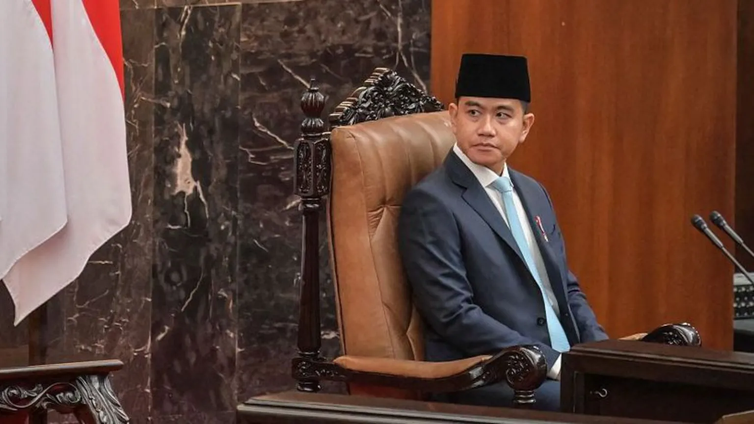
Indonesia’s VP Gibran Resigns Amid Explosive Diploma Scandal
Vice-President Gibran Rakabuming Raka has submitted his resignation to President Prabowo Subianto and parliament following court rulings over his educational qualifications and mounting political pressure
Indonesia’s Vice-President, Gibran Rakabuming Raka, on Thursday, November 12, 2026, submitted his resignation to President Prabowo Subianto and the country’s People’s Consultative Assembly in Jakarta, following a controversy over his educational qualifications that has triggered calls for his removal and intensified political tensions within the governing alliance.
Also read: Indonesia Detains 154 After Violent Protest Clashes
The 39-year-old vice-president, who is the eldest son of former Indonesian President Joko Widodo, popularly known as Jokowi, delivered his resignation letter to parliamentary leaders, according to Assembly Speaker Ahmad Muzani.
Muzani confirmed the development while speaking to journalists, saying Gibran had met parliamentary leaders to formally communicate his decision.
“He met with the leaders of the MPR today to submit his letter of resignation from his position as vice-president of the Republic of Indonesia,” Muzani said.
He added that Gibran had informed the parliamentary leadership that he had also submitted the resignation letter to President Subianto.
The development represents a major political setback for the young vice-president, whose eligibility for office has come under increasing scrutiny following two court rulings concerning documents submitted to establish the equivalence of his overseas education to an Indonesian high school qualification.
The controversy intensified after Indonesia’s Supreme Court, on October 30, 2026, overturned an earlier administrative court decision and annulled the educational equivalency certificate used by Gibran to satisfy the academic requirements for his 2024 vice-presidential candidacy.
The ruling followed an earlier Constitutional Court decision which found that there was insufficient convincing evidence establishing that Gibran possessed a foreign diploma or qualification equivalent to an Indonesian senior secondary school certificate.
However, the Constitutional Court declined to remove him from office, explaining that the case before it was not an appropriate legal procedure for overturning an already completed presidential election.
The legal controversy has since developed into a wider political confrontation, with lawmakers considering steps that could have led to impeachment proceedings against the vice-president.
On Wednesday, 120 members of Indonesia’s House of Representatives from eight political factions reportedly signed a proposal to exercise the legislature’s right to express an opinion on the diploma controversy.
The proposed parliamentary process could have paved the way for an investigation into whether Gibran remained constitutionally qualified to hold office.
His resignation came as that pressure was gathering momentum, although the precise legal effect of the submitted letter remains an important question.
Indonesia’s 1945 Constitution does not expressly provide a detailed procedure for a vice-president’s voluntary resignation. Legal commentators have therefore questioned how the authorities should formally process the departure and establish a vacancy.
The political implications extend beyond Gibran’s personal position.
His departure could reshape the relationship between President Subianto and his predecessor, Jokowi, whose political influence was instrumental in securing the victory of the Prabowo-Gibran ticket in the 2024 presidential election.
Gibran’s elevation to the vice-presidency had been widely viewed as an important part of the political alliance between the two leaders, with Jokowi’s support helping to strengthen the ticket’s electoral appeal.
However, relations between Subianto and the former president have reportedly come under strain, raising questions about the future of their political cooperation.
Executive Director of the Institute for Security and Strategic Studies, Khairul Fahmi, described the resignation as a significant political realignment but said it did not necessarily threaten the stability of the government.
“Jokowi will retain political influence, but Gibran’s departure could reduce his network’s direct access to power. For Prabowo, this creates greater room to consolidate his leadership and pursue his own political agenda,” Fahmi told AFP.
His assessment suggests that the development could give Subianto greater political independence while weakening the direct influence of Jokowi’s allies within the administration.
The resignation also comes at a time of growing public dissatisfaction with the Indonesian government over economic hardship, allegations of corruption, concerns about governance and the handling of widespread wildfires.
Thousands of people have taken part in demonstrations across the country in recent weeks, demanding better economic management, higher wages and greater accountability from public officials.
The protests have also drawn attention to the environmental consequences of prolonged wildfires, which have generated toxic haze and raised public health concerns in Indonesia and neighbouring countries.
On Tuesday, November 10, demonstrations took place in several cities, including Yogyakarta and Surabaya.
In Yogyakarta, approximately 100 protesters gathered near the provincial parliament at about 8pm before the demonstration turned violent.
Police said some protesters threw rocks, firecrackers and Molotov cocktails towards the parliament building, prompting security personnel to deploy tactical vehicles, tear gas and water cannon to disperse the crowd.
Yogyakarta police spokeswoman Novita Eka Sari confirmed that 154 people had been detained in connection with the unrest.
Officers also recovered six Molotov cocktails and 12 firecrackers, according to the police.
The unrest followed earlier demonstrations in Yogyakarta over minimum wages, while protesters in Surabaya, Indonesia’s second-largest city, raised concerns about wildfires and rising food prices.
The demonstrations have added to the political challenges facing Subianto’s administration, with economic concerns and questions about government accountability becoming increasingly prominent in public debate.
Under Indonesia’s constitutional arrangements, the resignation does not automatically trigger a fresh presidential election.
The People’s Consultative Assembly is expected to oversee the process of filling the vice-presidential vacancy, with the Constitution providing for the president to nominate two candidates and the Assembly to elect a replacement within 60 days.
Parliamentary leaders are expected to consider the next steps following receipt of Gibran’s letter.
Although Gibran’s departure marks a significant moment in Indonesia’s political history, its wider consequences will depend on how the constitutional process unfolds and whether Subianto can maintain the support of the political groups that helped bring his administration to power.
Also read: Skims Faces Backlash as Kim Kardashian Offers $148 Refunds
For now, the resignation has brought an extraordinary chapter in the country’s diploma controversy to a new stage, while leaving questions about political alliances, government stability and the future of Jokowi’s influence unresolved.




Pingback: Brooklyn Building Collapse Kills 2, Injures 17 in New York – FreshUpdates News