

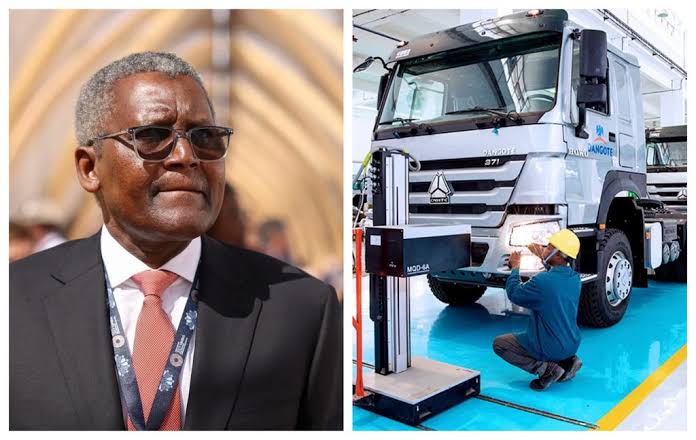
Dangote Unveils Africa’s First Locally Assembled Electric Truck
Dangote Group and China’s Sinotruk introduce a 350km-range electric heavy-duty truck assembled in Nigeria, signalling a major step towards cleaner commercial transportation and local vehicle manufacturing
Dangote Group has expanded its automotive manufacturing operations into electric mobility after unveiling a locally assembled heavy-duty electric truck in partnership with Chinese commercial vehicle manufacturer Sinotruk in Ikeja, Lagos.
Also read: UK Imports £1bn Nigerian Refined Fuel as Dangote Boosts Exports
The vehicle was unveiled on Sunday, November 15, 2026, at the Dangote Sinotruk assembly facility, with the company describing the development as a major milestone for Nigeria’s automotive industry and the transition towards cleaner commercial transportation.
The unveiling marks an expansion of the Dangote-Sinotruk joint venture beyond conventional diesel-powered and compressed natural gas (CNG) vehicles into electric commercial transportation.
According to details provided at the event, the truck features a 600-kilowatt-hour battery, a 375-kilowatt motor and a reported driving range of 350 kilometres, positioning it for applications in haulage, logistics and other heavy-duty transportation operations.
However, the technical specifications require clarification. A separate report by TheRadar identified a different electric truck configuration, with a 100kWh battery, a 95kW motor and a 200-kilometre range.
The publication also noted that the precise model and commercial specifications of the vehicle unveiled had not been fully established.
The difference in the reported specifications makes it important for prospective buyers and fleet operators to obtain confirmation of the exact model before making comparisons or investment decisions.
Speaking at the unveiling, Group Vice-President of Dangote Industries Limited, Devakumar Edwin, said the introduction of electric commercial vehicles reflected the company’s commitment to adopting emerging technologies and providing customers with more transportation options.
He explained that the partnership with Sinotruk was established to build a world-class commercial vehicle manufacturing business in Nigeria, strengthen local assembly capabilities, create employment and facilitate the transfer of advanced automotive technology.
“The whole objective of the JV was to establish a world-class commercial vehicle business in Nigeria and to bring the best of the technology from the world to Nigeria, strengthen the local assembly capabilities, create employment, and contribute to the economy and the development of the country,” Edwin said.
He noted that the company had progressively expanded its product portfolio to include heavy-duty trucks, tippers, light trucks, pickups and buses before introducing CNG-powered vehicles and now electric trucks.
According to Edwin, the move reflects the company’s determination to keep pace with developments in the global automotive industry while exploring transportation technologies with potential environmental and economic benefits.
He also pointed to China’s growing influence in electric vehicle technology, explaining that the partnership would allow Nigerian customers to access technologies developed in one of the world’s leading electric vehicle manufacturing markets.
“We are bringing in the best of the technology, which will also be highly protective of the Nigerian environment,” he said.
Edwin said electric commercial vehicles could offer operators an opportunity to reduce running expenses and vehicle emissions, although the actual savings would depend on electricity tariffs, charging availability and the nature of their operations.
“The electric commercial vehicle offers the potential for lowering the operating cost and reducing the tailpipe emissions, and depending on their application, the electricity and the electricity cost in the charging infrastructure is going to be highly beneficial to the people,” he said.
He acknowledged, however, that the transition would require more than simply introducing electric trucks into the market.
Reliable charging facilities, skilled technicians, readily available spare parts and effective after-sales services would be essential to building confidence among transport operators.
Edwin said Dangote Sinotruk was already preparing to provide the necessary technical and customer support, including assistance with charging infrastructure and maintenance.
“We recognise that this successful adoption will also require reliable charging facilities, technical expertise, spare parts and strong after-sales support,” he said.
“We are already getting ready with strong after-sales support. We are setting up our team. We are also going to support in terms of charging facilities and other technical expertise, whatever is required.”
He added that Dangote Group intended to develop its automotive business into one of West Africa’s leading vehicle assembly and manufacturing operations, leveraging Nigeria’s large domestic market and industrial potential.
The company also plans to strengthen technology transfer through training programmes that will give Nigerian engineers and technicians opportunities to acquire practical experience, including training at Sinotruk facilities in China.
Also speaking at the event, Sinotruk Group President, Liu Wei, described the unveiling as a significant milestone in the 16-year relationship between both companies and an important development for Africa’s commercial vehicle manufacturing industry.
“Most importantly, this is the very first new energy truck ever assembled on the African continent. This is truly a historic moment,” Liu said.
He traced the partnership to 2010, when both companies began working towards establishing a commercial vehicle manufacturing business in Nigeria.
The collaboration was formalised into a joint venture in 2014, with its first heavy-duty truck rolling off the assembly line in 2017.
In 2024, the partnership expanded its manufacturing capabilities with the commencement of operations at its commercial vehicle welding and e-coating paint line, representing a transition towards more advanced local production.
Liu disclosed that the joint venture had assembled more than 8,000 vehicles locally over the past decade.
He said Sinotruk would continue investing in production-line upgrades, expanding its vehicle range and developing Nigerian engineering talent to strengthen the country’s automotive manufacturing capacity.
The planned expansion will cover heavy-duty trucks, light trucks, pickups, trailers and vehicle body-building.
Liu also said the partnership’s ambitions aligned with Dangote Group’s broader industrialisation strategy and its target of generating $100 billion in revenue by 2030.
The Lagos State Government welcomed the development, with its representative at the event describing the rollout as an important step for the state’s industrial and transportation sectors.
The introduction of the electric truck comes several years after Nigeria’s first locally assembled electric passenger car, the Hyundai Kona, was unveiled by Stallion Group in Lagos in November 2020 and subsequently presented by the National Automotive Design and Development Council in Abuja in February 2021.
The Federal Government’s Energy Transition Plan also identifies electric mobility as part of Nigeria’s longer-term strategy for reducing transportation emissions, while highlighting the need for supporting infrastructure and investment.
However, the commercial prospects of locally assembled electric trucks will depend significantly on Nigeria’s electricity supply, charging infrastructure, acquisition costs and maintenance capacity.
A November 16 report by TheRadar highlighted the limited information publicly available about the newly unveiled vehicle, including its final price, production volume, payload capacity and expected delivery schedule.
It also raised questions about the suitability of the different reported battery and range specifications for long-distance haulage.
These considerations will be particularly important for logistics companies and fleet operators seeking to determine whether electric trucks can deliver meaningful savings compared with conventional diesel-powered vehicles.
Also read: Dangote Eyes Major 500,000-Tonne Cocoa Deal in Ghana
Nevertheless, the Dangote-Sinotruk initiative represents a notable development in Nigeria’s efforts to expand local automotive manufacturing, deepen technology transfer and participate in the emerging electric commercial vehicle market.




Pingback: Dangote Refinery Shares to Begin Trading on NGX December 1 – FreshUpdates News
Pingback: FG Targets 984MW Power Boost Through Five Substation Upgrades – FreshUpdates News