

FG Reports Major Health Breakthrough, Rebuilds 3,526 Primary Healthcare Centres
Health Minister Muhammad Pate says the Tinubu administration has expanded healthcare access, recruited nearly 20,000 skilled birth attendants and increased insurance coverage, but acknowledges persistent challenges in patient satisfaction and maternal health
The Federal Government says it has fulfilled all 41 performance commitments set for Nigeria’s health sector under President Bola Ahmed Tinubu, reporting the revitalisation of 3,526 primary healthcare centres and expanded access to health insurance for millions of Nigerians.
Also read: NCDC Clarifies ₦10bn Ebola Fund, Lists 7 Health Threats
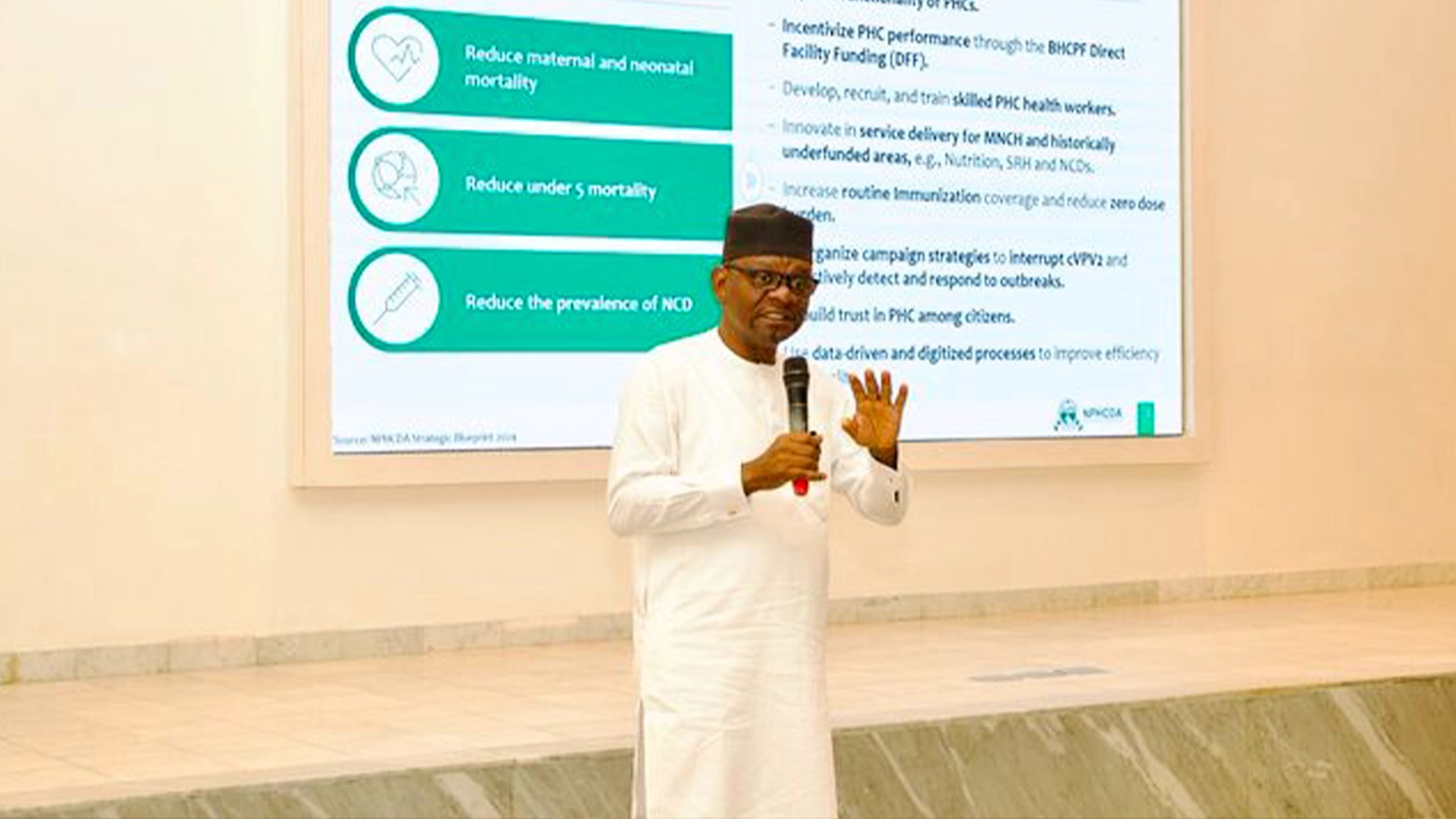
Coordinating Minister of Health and Social Welfare, Professor Muhammad Ali Pate, disclosed this on Tuesday, November 10, 2026, in Abuja, during the third Nigeria Health Sector Joint Annual Review, where he presented an account of the administration’s progress under the Nigeria Health Sector Renewal Investment Initiative.
Pate said the government was working on another 900 primary healthcare centres, while 19,758 skilled birth attendants had been recruited across 22 states. He added that 78,054 frontline health workers had received training as part of efforts to improve healthcare delivery at community level.
According to the minister, health insurance coverage had increased from approximately 16 million Nigerians at the beginning of the administration to nearly 24 million.
The reported achievements form part of the government’s broader health sector reform programme, launched in December 2023 to improve healthcare financing, strengthen primary healthcare, expand access to essential services and address persistent weaknesses in the country’s health system.
The primary healthcare revitalisation programme is particularly significant because these facilities serve as the first point of contact for many Nigerians, especially people in rural and underserved communities.
The National Primary Health Care Development Agency has previously explained that the initiative involves infrastructure upgrades, improved access to essential medicines, equipment, electricity, water supply and the recruitment and retention of healthcare workers.
Its longer-term ambition is to establish at least one functional primary healthcare facility in every ward.
On healthcare financing, Pate said cumulative releases under the Basic Health Care Provision Fund had reached N422.3 billion, with N249.5 billion disbursed under the Tinubu administration.
The fund is an important financing mechanism for primary healthcare, health insurance and emergency medical services, particularly for vulnerable populations.
However, figures released by the Federal Government in October showed that N422.3 billion had been released to the fund as of September 2026, while total disbursements since its inception stood at N323.6 billion.
The government said an additional N40.76 billion had subsequently been approved for the third quarter of 2026.
Maternal and newborn healthcare also featured prominently in the minister’s assessment.
Pate said skilled deliveries at supported healthcare facilities increased from 4.8 million in 2023 to 7.9 million by the second quarter of 2026, while antenatal care visits rose from six million to 8.7 million.
He disclosed that the free emergency obstetric care programme had provided nearly 100,000 services within two years, including 80,906 caesarean sections and 6,059 vesicovaginal fistula repairs.
The minister further reported an approximately 60 per cent decline in maternal case fatality in areas covered by the Maternal and Newborn Mortality Reduction Innovation Initiative between 2024 and 2026.
The reported improvement comes amid intensified government efforts to address Nigeria’s maternal mortality burden through better-equipped facilities, emergency obstetric services and financial support for women who cannot afford essential medical treatment.
The Maternal and Newborn Mortality Reduction Innovation Initiative initially concentrated interventions in 172 local government areas identified as having particularly high maternal mortality burdens.
Beyond maternal healthcare, the government said it had introduced financial relief measures to reduce the burden of medical expenses on patients.
Pate disclosed that dialysis costs had been reduced by as much as 80 per cent for 5,106 patients, while more than 15,000 Nigerians had benefited from the free 48-hour emergency medical care programme.
He also highlighted progress in domestic pharmaceutical and medical manufacturing, revealing that 10 factories or production lines had been commissioned, six of them in 2026.
The initiative is part of efforts to reduce Nigeria’s dependence on imported medicines and medical products, strengthen local manufacturing capacity and improve the availability of essential healthcare supplies.
Despite the reported gains, Pate acknowledged that some indicators had moved in the wrong direction.
He disclosed that stunting had worsened slightly, while patient satisfaction with healthcare services declined from 76 per cent in 2024 to 71 per cent in 2026.
The figures highlight the gap between increased government investment and the quality of services experienced by patients, particularly in a country where access to affordable and reliable healthcare remains a major concern.
The Minister of State for Health and Social Welfare, Dr Iziaq Adekunle Salako, said almost eight million additional Nigerians had been enrolled in health insurance under the administration, including more than three million vulnerable persons.
Salako said the government was targeting at least 90 per cent functional primary healthcare centres by 2031, alongside 40 per cent health insurance coverage.
He added that the administration planned to expand the maternal and newborn mortality reduction initiative to all 774 local government areas.
According to him, the annual review must go beyond the presentation of statistics to ensure that reported achievements translate into measurable improvements in the lives of Nigerians.
The three-day meeting, holding from November 10 to 12 under the theme, “Together to Higher Grounds”, brings together government officials, healthcare professionals, development partners and other stakeholders to assess progress and identify areas requiring urgent intervention.
Earlier, the Permanent Secretary of the Federal Ministry of Health and Social Welfare, Daju Kachollum, disclosed that all 36 states and the Federal Capital Territory had conducted their respective annual health sector reviews.
However, she raised concerns about persistent shortages of healthcare workers, poor maternal and child health indicators and weaknesses in emergency response systems.
Kachollum revealed that only 22 per cent of public health events achieved the seven-day early response target, underscoring continuing gaps in the country’s capacity to detect and respond promptly to health emergencies.
Nigeria’s health sector has faced longstanding challenges, including inadequate funding, insufficient medical personnel, limited access to quality primary healthcare and high out-of-pocket expenditure.
The Nigeria Health Sector Renewal Investment Initiative, launched in December 2023, was designed to address these structural problems through improved coordination between federal and state governments, stronger domestic financing, better accountability and expanded access to essential healthcare.
The initiative also received commitments of more than $2.2 billion towards its reform objectives, including plans to renovate more than 17,000 primary healthcare centres, train 120,000 frontline health workers and expand health insurance coverage.
While the Federal Government’s declaration that all 41 performance commitments have been achieved represents a significant milestone in its assessment of the reform programme, the decline in patient satisfaction and continuing workforce and emergency response challenges suggest that sustaining those gains will require further investment and stronger accountability.
Also read: Public Health Awareness Remains Essential
Ultimately, the success of the reforms will depend not only on the number of facilities renovated or people enrolled in insurance schemes, but also on whether Nigerians can access affordable, adequately staffed and dependable healthcare when they need it.



