

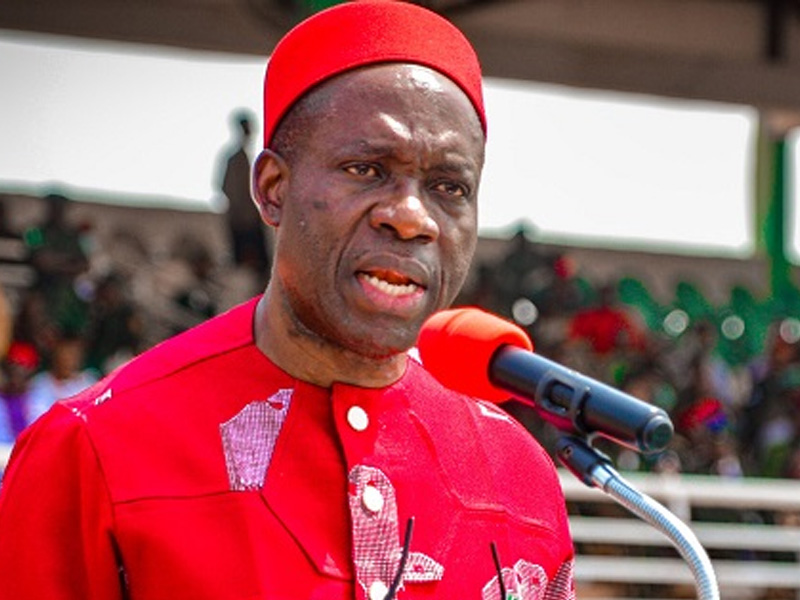
Soludo Urges Nigerians to Embrace Made-in-Nigeria Products
The Anambra governor says prioritising locally produced food, clothing and drinks could accelerate industrialisation, attract foreign investment and create millions of jobs
Anambra State Governor, Professor Chukwuma Charles Soludo, has challenged Nigerians to embrace economic patriotism by prioritising locally manufactured goods, arguing that a nationwide shift towards Nigerian-made products could accelerate industrialisation, attract foreign investment and create millions of jobs.u
Also read: NiDCOM Tackles Gambia Over Directive Threatening Jobs of 57 Nigerians
Soludo made the appeal on Thursday, November 12, 2026, while delivering the keynote address at the presentation of Economic Diversification and Structural Transformation in Nigeria: Past, Present, Future, a book authored by Abdulmumin Jibrin, at the State House Conference Centre, Presidential Villa, Abuja.
President Bola Tinubu, who wrote the book’s foreword, attended as special guest of honour, while Chairman of BUA Group, Abdul Samad Rabiu, presented the publication. Former presidential spokesman, Dr Reuben Abati, served as the book’s reviewer.
The former Central Bank of Nigeria governor, who appeared at the event in traditional Akwete fabric, said Nigeria’s economic transformation would require a change in citizens’ attitudes towards locally produced goods rather than relying exclusively on government policies and institutional reforms.
He argued that individual purchasing decisions, when multiplied across a population of more than 200 million people, could generate substantial demand for Nigerian industries and encourage domestic and foreign investors to establish production facilities in the country.
“Imagine for a moment if all Nigerians only eat and wear made in Nigeria.
“Imagine the millions of jobs and the FDI that will relocate to exploit the Nigerian market,” Soludo said.
Using his clothing as an example, the governor disclosed that he had made Akwete fabric his daily attire since his daughter introduced him to it in 2020.
He also revealed that First Lady Senator Oluremi Tinubu had announced plans to wear the traditional fabric during President Tinubu’s second-term inauguration on May 29, 2027.
“Since my daughter introduced me to Akwete in 2020, it has been my daily uniform, and I thank the First Lady of Nigeria who has announced that she will wear it for the second term inauguration on May 29 next year,” he said.
Soludo further pointed to the eagle symbol on his attire, describing it as a representation of Nigeria’s national identity.
“So I carry my own Nigeria on my head every day,” he added.
The governor said his commitment to local patronage extended beyond personal fashion choices to the administration of Anambra State.
He disclosed that the Governor’s Lodge in Awka prioritised Nigerian-made food and beverages when hosting visitors, except on very rare occasions.
“At the Governor’s Lodge in Awka, we only offer made-in-Nigeria food and drinks, except on exceedingly rare occasions.
“If you come to Anambra, we offer you wine, not champagne,” he said.
Soludo also proposed a nationwide campaign to encourage Nigerians to embrace locally produced fabrics, suggesting that Nigerian textiles should become compulsory at official government functions and other formal national gatherings.
” Wear only Nigerian fabrics at all official events, and later then every day, and all the fabric-making companies in the world will start flooding to Nigeria,” he said.
He maintained that consistent patronage of domestic products would encourage manufacturers to expand production, create employment and attract foreign direct investment into the country.
The former CBN governor also challenged Nigerians to take greater responsibility for the country’s economic difficulties instead of consistently attributing them to external forces.
“Let us point the fingers at ourselves for once, rather than at them. What are you doing every day to create jobs, reduce poverty, improve diversification and transformation? Simple habits and preferences add up,” he said.
Emphasising the importance of national confidence, Soludo argued that economic development was not simply a technical exercise involving policies and institutions but also depended on the collective mindset of citizens.
“Development is attitude; it is self-belief. Nothing ever got built or sustained without the team or society believing in themselves or a national consciousness,” he said.
He concluded his appeal with a declaration of national pride, saying: “I am Nigerian. I am proud. I wear made in Nigeria.”
Soludo’s remarks reflect his longstanding advocacy for greater domestic consumption as a strategy for expanding Nigeria’s productive capacity.
In October 2024, he similarly argued that widespread patronage of locally manufactured textiles could generate between five million and 10 million jobs, particularly through the revival of the country’s textile industry.
He also cited his use of an Innoson vehicle and Akwete clothing as examples of supporting indigenous production.
He reiterated the position at the Delta State Economic and Investment Summit in August 2026, where he called for a shift away from imported products towards locally manufactured alternatives, linking domestic consumption to employment generation and industrial growth.
However, the governor’s appeal comes against the backdrop of significant challenges confronting Nigerian manufacturers, including high energy costs, inadequate infrastructure, expensive financing and competition from imported goods.
A Development Bank of Nigeria research note published in October 2026 showed that manufactured goods imports reached approximately ₦35.99 trillion in 2025, compared with manufactured exports of about ₦2.50 trillion.
The report also found that manufacturing’s contribution to real gross domestic product declined from 10.22 per cent in 2014 to 8.05 per cent in 2025, highlighting the gap between domestic consumption and the country’s industrial production capacity.
Development Bank of Nigeria
Similarly, the Nigerian Investment Promotion Commission has identified unreliable electricity, high logistics costs and competition from cheaper imports among the major constraints affecting the country’s manufacturing sector.
These challenges underline the need for economic patriotism to be accompanied by policies that improve the operating environment for local businesses, strengthen production capacity and make Nigerian products affordable and competitive.
Nevertheless, Soludo’s message places renewed emphasis on the role consumers can play in shaping the country’s economic future, arguing that supporting local producers should become a deliberate national habit rather than an occasional expression of patriotism.
Also read: 2027: Atiku Insists on Fuel Subsidy Return, Promises Cheaper Petrol
His central argument is that Nigeria’s ambition to diversify its economy and create sustainable employment must involve both government action and a conscious commitment by citizens to support the businesses and industries producing within the country.




Pingback: FG Signs Port Harcourt Airport Deal, Assures Workers – FreshUpdates News