

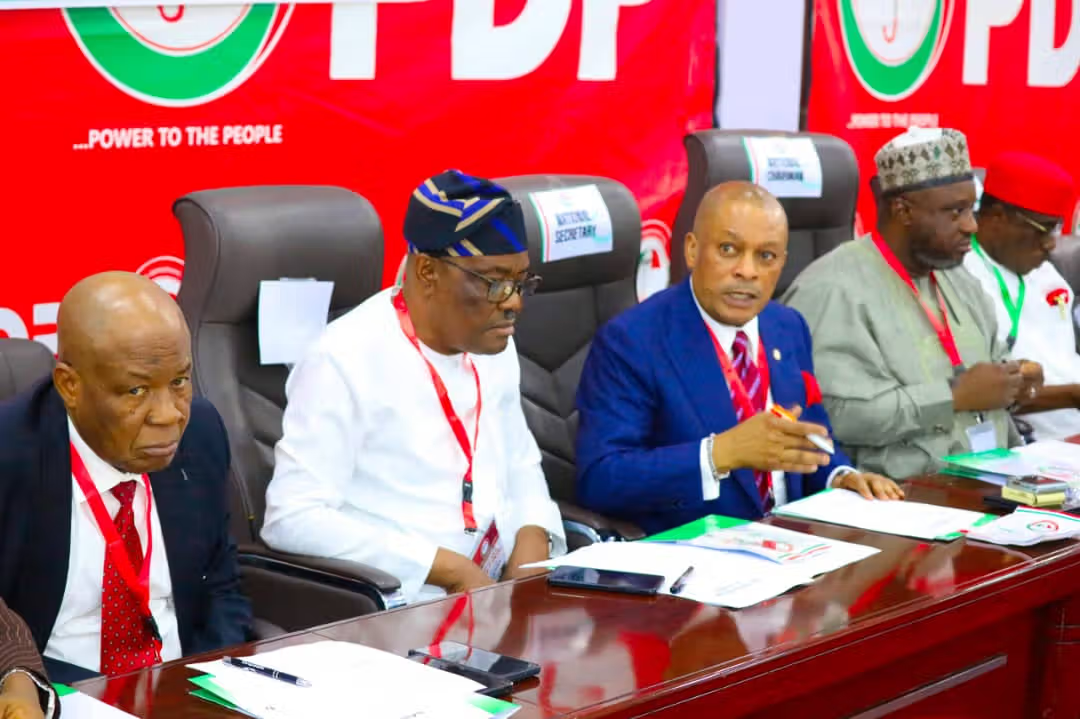
Wike-Led PDP Faction, NRM Advocate More Women in Decision-Making
The parties call for greater female representation in political leadership, with the NRM citing its decision to give women key party positions and a presidential ticket
PDP and NRM have called for greater female representation in Nigeria’s political leadership ahead of the 2027 general elections, urging political parties to translate their promises of inclusion into tangible opportunities for women to contest elections and occupy strategic positions.
Also read: Wike Declares Obi’s 2027 Political Wave ‘Dead’
The appeal was made on Thursday, November 12, 2026, at the National Women Summit organised by the National Rescue Movement (NRM) in Abuja, where representatives of the two parties highlighted the contributions of women to political mobilisation and the need to address their persistent exclusion from decision-making.
Speaking on behalf of the National Chairman of the Wike-led PDP faction, Abdulrahman Mohammed, a member of the party’s Board of Trustees, Dr Helen Adebakin, said women had consistently demonstrated their capacity as mobilisers, strategists, organisers and leaders.
She, however, expressed concern that despite their contributions to political parties, women were frequently sidelined when leadership positions and other opportunities were distributed.
Adebakin said the practice of celebrating women during election campaigns without giving them meaningful opportunities to participate in governance needed to change.
“Yet, too often their contributions are celebrated during campaigns, but their voices are diminished when the opportunity for leadership and decision-making arrives. This contradiction must end,” she said.
She described increased female representation in parliament as both a democratic necessity and a development priority, arguing that political parties must move beyond public declarations and establish practical mechanisms to support women’s political ambitions.
According to her, achieving meaningful inclusion would require deliberate policies, institutional commitment, financial support, mentorship and the removal of structural barriers that discourage women from participating in politics.
“Women deserve more than ceremonial opportunities.
They deserve meaningful opportunities to contest elections, occupy strategic leadership positions, influence public policies, and participate directly in determining the direction of our nation,” Adebakin added.
Also addressing the gathering, NRM National Chairman, Chinedu Obi, said his party had taken steps to demonstrate its commitment to gender inclusion through the allocation of important leadership positions to women.
Obi disclosed that the party had given its highly contested organising secretary position to a woman, describing the decision as evidence of its willingness to recognise female leadership within its structure.
“In NRM, all the he’s in NRM are for she’s.
That is why NRM is the only party in Nigeria today that has one of the most struggled for positions, which is the organising secretary. It’s only NRM that carried the position of organising secretary and gave it to a woman,” he said.
He also revealed that the party selected a female presidential flag bearer after screening three qualified aspirants, presenting the decision as another demonstration of its commitment to expanding women’s participation in national politics.
“When we got to that three, the three of them were all qualified, but we looked at them and we said, this woman would carry our flag. And we became the first political party that carried our flag and gave it to a woman,” Obi said.
The NRM chairman urged women to strengthen the party’s structures across the country and intensify grassroots mobilisation ahead of the 2027 elections.
He maintained that women and young people remained indispensable to electoral success, stressing that political parties could not build effective nationwide campaigns without their participation.
“If there’s no women, there won’t be any elections,” he said.
Obi also encouraged women to use their voting strength to demand political change, citing poverty, insecurity and economic difficulties as issues requiring greater attention from political leaders.
The renewed appeal comes against the backdrop of Nigeria’s persistently low female representation in elective positions, despite women accounting for a substantial proportion of the electorate and playing significant roles in political campaigns.
Data from the Inter-Parliamentary Union (IPU) show that women occupied 15 of the 356 filled seats in Nigeria’s House of Representatives, representing 4.2 per cent of its membership, based on its January 2025 chamber data. In the Senate, women held four of 107 occupied seats, representing 3.7 per cent.
The figures highlight the gap between women’s participation in electioneering and their access to elected legislative positions.
Following the 2023 general elections, only three women secured seats in the 109-member Senate, while 14 women initially emerged victorious in the House of Representatives elections, according to the IPU’s election records.
The European Union Election Observation Mission’s report on the 2023 elections also identified several obstacles to women’s political participation, including the high cost of campaigns, political violence, party gatekeeping and the limited opportunities available during candidate selection.
The report noted that women accounted for approximately 10 per cent of candidates across the national and state elections, illustrating the difficulties female aspirants face even before reaching the general election stage.
Nigeria’s National Gender Policy for 2021 to 2026 also prescribed a 35 per cent representation target for women in elected and appointed positions. However, the country has not established a binding electoral gender quota to guarantee women’s representation in parliament, according to International IDEA.
The debate over women’s political inclusion has therefore extended beyond election campaigns, with gender advocates and civil society organisations repeatedly urging political parties to address financial, institutional and cultural barriers limiting female participation.
The NRM and the Wike-led PDP faction’s latest position places renewed attention on the responsibility of political parties to provide women with opportunities to compete for elective offices and influence decisions within their organisations.
Also read: APC Unveils Tinubu’s 2027 Agenda With Bold 4-Pillar Plan
With the 2027 general elections approaching, the extent to which political parties translate such commitments into nominations, campaign support and actual representation will remain an important measure of progress towards gender inclusion in Nigeria’s democratic process.



