

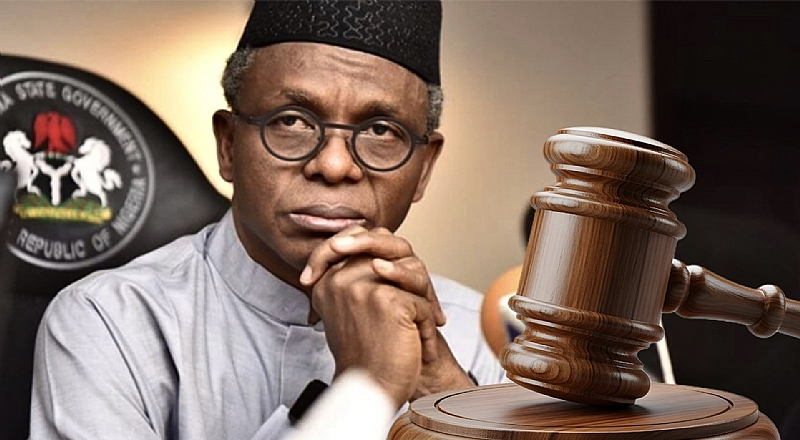
Court to Deliver Judgment in El-Rufai’s N10bn Rights Violation Case
The Federal High Court in Abuja will deliver judgment after examining CCTV footage and hearing arguments from the former governor, the ICPC and the Attorney-General of the Federation
The Federal High Court in Abuja has fixed December 8, 2026, for judgment in a ₦10 billion fundamental rights suit filed by former Kaduna State Governor, Nasir El-Rufai, against the Independent Corrupt Practices and Other Related Offences Commission (ICPC), its chairman, Musa Aliyu, and the Attorney-General of the Federation, Lateef Fagbemi.
Also read: Lagos Court Jails Couple Over ₦67.6m Property Fraud
El-Rufai is seeking damages over allegations that the anti-corruption commission prevented his wife, Aichatou Asabe, and son, Abba, from visiting him while he was in its custody.
Justice Chigozie Onah fixed the judgment date on Wednesday, November 4, after lawyers representing the parties adopted their court processes and presented their final arguments.
The proceedings also featured the playing of selected closed-circuit television (CCTV) recordings from the ICPC’s premises.
The footage was presented to support the opposing accounts of the circumstances surrounding the restriction of visits to the detained former governor.
The court had directed each side to use 20 minutes to present relevant portions of the recordings.
Among the clips shown were images of an incident on July 7, when Asabe reportedly arrived at about 2:37pm, accompanied by an officer, to deliver food to her husband.
Footage relating to an encounter involving Abba and an earlier visit by Asabe on July 4 was also presented.
El-Rufai’s lawyer, Ubong Akpan, asked the court to replay some portions of the recordings, arguing that the footage did not establish that either Asabe or Abba had breached security procedures in a manner that justified denying them access.
Adopting the former governor’s processes, Akpan said the originating motion was filed on August 13 and supported by an eight-paragraph affidavit, exhibits, a written address and four additional affidavits.
He urged the court to determine whether the respondents had presented sufficient material evidence to justify the decision to restrict his client’s family members from visiting him.
The lawyer argued that any restriction on access to a detained person must have a verifiable and legally justifiable basis.
He also maintained that denying El-Rufai access to his relatives amounted to a breach of his rights, citing the Nelson Mandela Rules as an international standard governing the treatment of people in detention.
When Justice Onah questioned whether the rules were enforceable in Nigeria, Akpan described them as standards guiding law enforcement agencies internationally.
The ICPC, however, rejected the former governor’s position and urged the court to dismiss the suit.
Its lawyer, Yetunde Mosunmola, said the commission and its chairman had filed a 27-paragraph counter-affidavit, supported by four exhibits and a written address, on August 31. She added that a further counter-affidavit was filed on September 28.
Mosunmola argued that El-Rufai was being held lawfully and that visits to detainees must comply with security procedures established within the facility.
She maintained that the CCTV recordings showed that Asabe breached the commission’s security protocols on two occasions.
According to her, Asabe was allegedly brought into the ICPC premises after official visiting hours on July 4 with the assistance of some officers. She said the officers involved were subjected to disciplinary action, with one subsequently dismissed.
The lawyer also argued that the commission was entitled to review its access arrangements following the alleged breaches, insisting that relatives of detainees could not be granted unrestricted access where security rules applied.
She further told the court that other members of El-Rufai’s family, including another wife, were allowed to visit him, maintaining that the restriction was specific to Asabe because of her alleged conduct.
Mosunmola consequently urged the judge to hold that the ICPC had not unlawfully interfered with the former governor’s fundamental rights.
The Attorney-General of the Federation also opposed the suit. Its representative, Maimuna Lami-Shiru, Director of Civil Litigation and Public Law, said the office had filed a seven-paragraph affidavit on September 11, alongside a written address and a reply on points of law.
Lami-Shiru argued that the ICPC and its chairman acted within the law and that the restriction followed an alleged breach of the commission’s security protocols.
In its counter-affidavit, the ICPC, through John Uche, a Chief Anti-Corruption Assistant in its Internal Security Support Unit, disputed several claims contained in El-Rufai’s supporting affidavit.
Uche said the former governor was being held under an order of the Federal High Court in Kaduna in a separate criminal proceeding marked FHC/KD/73C/2025.
He also stated that the commission facilitated a medical visit on July 7 in compliance with the Kaduna court’s order, allowing El-Rufai to see his personal physician, accompanied by ICPC officers and his wife.
However, Uche alleged that the visit was subsequently reported to have turned into a political meeting, contrary to the commission’s security procedures.
He said the development raised concerns about the facility’s access-control arrangements, prompting the ICPC to introduce temporary restrictions on non-essential visits while reviewing its security measures.
Uche further alleged that Abba was prevented from entering the building on July 7 and subsequently lay in a gutter, repeatedly rubbing his leg against its edge.
He also maintained that the CCTV recordings were accurate and had not been altered or tampered with.
The ₦10 billion action, marked FHC/ABJ/CS/1852/2026, contains nine reliefs, including a request for the court to declare that El-Rufai’s fundamental rights under Part IV of the 1999 Constitution, as amended, remain enforceable despite his detention.
The case will now be decided on December 8, when Justice Onah is expected to determine whether the restrictions imposed on visits by the former governor’s wife and son were legally justified.
Also read: Lagos Court Jails Couple Over ₦67.6m Property Fraud
The judgment will bring a major stage of the dispute to a close, although the separate criminal proceedings involving El-Rufai remain distinct from the fundamental rights action.