

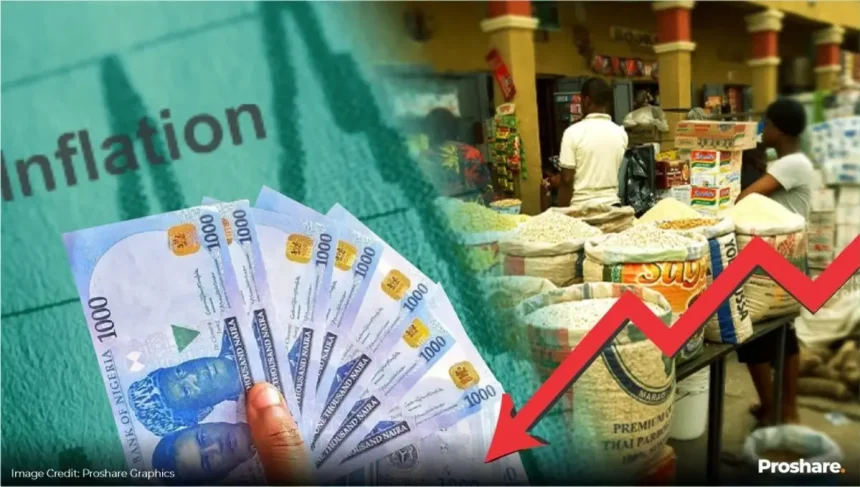
Nigeria Inflation Drops to 14.06% in October Despite Rising Monthly Prices
Annual inflation eases from 14.63 per cent in September, but faster monthly price increases and persistent food costs continue to challenge households
Nigeria’s headline inflation rate declined to 14.06 per cent in October 2026 from 14.63 per cent in September, offering further evidence of easing annual price pressures, although the pace of monthly increases accelerated during the period.
Also read: UK Imports £1bn Nigerian Refined Fuel as Dangote Boosts Exports
The National Bureau of Statistics (NBS), through its October 2026 Consumer Price Index (CPI) report released on Monday, November 16, disclosed that the latest figure represented a 0.57 percentage-point reduction from September and a more substantial 4.91 percentage-point decline from the 18.97 per cent recorded in October 2025.
The development extends Nigeria’s disinflationary trend, suggesting that the rate at which consumer prices are rising annually has continued to moderate.
However, the improvement does not necessarily mean that goods and services have become cheaper. Rather, it indicates that prices are increasing at a slower annual rate than they did previously.
The distinction is particularly important for households still grappling with elevated costs of food, transportation, accommodation and other essential services.
Despite the decline in annual inflation, the NBS report revealed that month-on-month headline inflation increased to 0.43 per cent in October from 0.06 per cent in September.
This represents a 0.37 percentage-point acceleration, indicating that average consumer prices increased more quickly during October than in the preceding month.
The Consumer Price Index also rose to 147.0 points in October from 146.4 points in September, reinforcing the indication that the overall price level continued to move upwards.
According to the NBS, the average inflation rate over the 12 months ending October 2026 stood at 15.40 per cent, significantly below the 26.05 per cent recorded during the corresponding period of 2025.
The figures therefore present a mixed picture for the Nigerian economy, with annual inflation moderating while short-term price pressures remain uneven.
Food prices remained a major concern despite the overall moderation in inflation. The NBS put year-on-year food inflation at 19.13 per cent in October, compared with 16.30 per cent in October 2025.
On a month-on-month basis, however, food inflation remained negative at -0.75 per cent, compared with -1.55 per cent in September.
This indicates that average food prices continued to decline during the month, although the pace of the reduction slowed considerably.
The bureau attributed the movement to changes in the prices of several commonly consumed products, including vegetable oil, Titus sardines, green peas, frozen mackerel, croaker fish, locally produced rice, fresh catfish, beef tripe, palm oil and millet flour.
The NBS explained the difference in monthly price movements, stating: “This means that in October 2026, the rate of increase in the average price level was higher than the rate of increase in the average price level in September 2026.”
Core inflation, which excludes volatile agricultural produce and energy prices, also moderated to 10.78 per cent year-on-year in October.
On a month-on-month basis, core inflation declined by 0.53 per cent, reversing the 1.11 per cent increase recorded in September. This suggests that underlying price pressures eased during the review period.
The geographical breakdown showed that urban inflation stood at 14.84 per cent year-on-year, while rural inflation was lower at 12.17 per cent.
On a monthly basis, urban inflation moderated to 0.43 per cent from 0.53 per cent in September. Rural inflation, however, increased to 0.18 per cent from a negative 0.89 per cent in the preceding month.
The 12-month average inflation rates for urban and rural areas stood at 15.59 per cent and 14.79 per cent respectively, compared with 26.99 per cent and 24.58 per cent recorded in October 2025.
An analysis of the contributions to monthly headline inflation showed that food and non-alcoholic beverages remained the largest contributor, accounting for 0.17 percentage points.
Restaurants and accommodation services followed with 0.06 percentage points, while transport contributed 0.05 percentage points.
Housing, water, electricity, gas and other fuels accounted for 0.04 percentage points. Education services and health each contributed 0.03 percentage points.
Clothing and footwear contributed 0.02 percentage points, while information and communication, personal care and household-related services each accounted for 0.01 percentage points.
The latest figures come against the backdrop of Nigeria’s prolonged cost-of-living difficulties, which have placed considerable pressure on household budgets and business operating costs.
Although the decline in annual inflation represents a welcome development, the continued rise in the overall Consumer Price Index means that consumers are yet to experience a broad reduction in the cost of everyday goods and services.
The figures also highlight the importance of sustaining improvements in food supply, transportation, energy costs and other factors influencing consumer prices.
For policymakers, the October report provides some encouragement that inflationary pressures are moderating. However, the acceleration in monthly headline inflation suggests that the progress remains uneven.
The extent to which the downward trend can be sustained will depend on whether improvements in food availability, exchange-rate stability and other economic conditions translate into more consistent price moderation across the country.
Also read: N630bn Power Debt: Stakeholders Warn Nigeria’s Electricity Crisis May Deepen
The NBS figures therefore offer a cautiously positive picture of Nigeria’s inflation outlook, with annual inflation easing further but the pressure on household purchasing power remaining a significant concern.




Pingback: Food Inflation Hits 20% in 19 States Despite National Decline – FreshUpdates News