

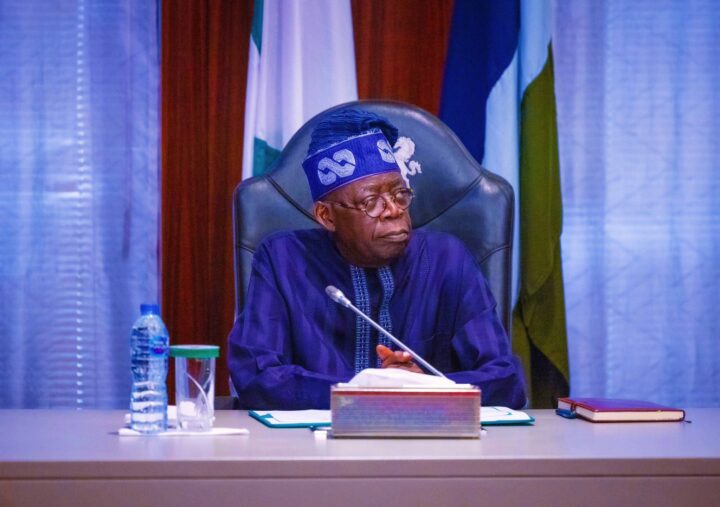
Tinubu Reports 1,000 Terrorist Convictions in Nigeria
The President says security forces have killed or arrested four of eight identified senior terrorist leaders, while urging intelligence agencies to embrace modern surveillance technology
President Bola Ahmed Tinubu has disclosed that more than 2,000 suspected terrorists are undergoing prosecution in Nigeria, while over 1,000 others have been convicted, as his administration intensifies efforts to dismantle insurgent and terrorist networks across the country.
Also read: Tinubu Grants Clemency to 78 Suspects Over Abuja Convoy Attack
Tinubu, represented by the National Security Adviser (NSA), Nuhu Ribadu, made the disclosure on Monday, November 16, 2026, at the opening of the 2026 Chief of Defence Intelligence (CDI) Annual Conference in Abuja.
The President also revealed that Nigerian security forces had killed or arrested four of eight identified senior terrorist leaders, describing the development as evidence of improved intelligence gathering, operational coordination and the country’s growing capacity to disrupt terrorist organisations.
The five-day conference, holding from November 16 to 20, is themed Optimising Intelligence Through Technological Innovation and Strategic Partnership in a Complex Security Environment.
Highlighting the operational achievements recorded by security agencies, Tinubu cited the killing of senior Islamic State leader Abu Bilal al-Minuki in May 2026 as a major breakthrough in Nigeria’s counterterrorism campaign.
Al-Minuki was killed during a joint Nigerian and United States military operation in northeastern Nigeria on May 16.
The US Africa Command confirmed that the operation targeted senior Islamic State figures, including Al-Minuki, who was described as the group’s director of global operations.
The President also identified the arrests of Abu Barra of Ansaru and Mamuda of Mahmudawa in 2025 as significant developments in efforts to weaken terrorist command structures.
He further highlighted operations targeting the southern expansion network of the Islamic State West Africa Province (ISWAP), associated with Ahmed Ohida.
However, Tinubu acknowledged that several prominent terrorist commanders remained at large, with security agencies continuing efforts to track and apprehend them.
Those identified include Ba Shuwa of ISWAP, Abdullahi Oro of Islamic State in the Sahel (IS-Sahel), Sadiku of Jama’atu Ahlis Sunna Lidda’awati wal-Jihad (JAS) in the North-Central region and Bakura Doro in the Lake Chad Basin.
The President also disclosed that security forces had eliminated senior bandit commanders, including Halilu Sububu, alongside several fighters operating across the country.
He attributed the reported successes to stronger intelligence sharing and coordinated operations involving the Department of State Services (DSS), the Armed Forces, the Nigeria Police Force and other security institutions.
Tinubu, however, cautioned that the achievements would only translate into lasting security if the pressure on terrorist groups, bandits and other criminal organisations was sustained.
He called for greater investment in modern intelligence capabilities, particularly artificial intelligence, machine learning, geospatial intelligence and unmanned surveillance systems, to improve threat detection and support security operations.
According to him, emerging technologies could help security agencies identify threats more quickly, monitor criminal movements and improve operational decision-making.
The President also warned against relying entirely on artificial intelligence-generated intelligence, insisting that information obtained through such systems must undergo human verification.
He stressed the importance of maintaining appropriate data protection and cybersecurity safeguards while adopting modern technologies for national security operations.
In another major announcement, Tinubu disclosed that he had directed his Special Adviser on Homeland Security, Major General A.A. Famadewa (rtd), to coordinate the preparation of a Comprehensive National Threat Assessment and a Five-Year Rolling Strategic Defence Operations Plan.
The initiative is expected to provide a more coordinated framework for identifying emerging security threats, strengthening defence planning and improving cooperation among Nigeria’s intelligence and security institutions.
The directive builds on an earlier presidential initiative announced in August 2026, when Tinubu approved the preparation of a comprehensive national threat assessment and a rolling five-year defence operations strategy.
The State House, Abuja
He said the proposed framework would ensure that national security decisions were guided by reliable intelligence, institutional coordination and forward-looking operational strategies.
Tinubu also urged Nigerian security agencies to strengthen cooperation with regional and international partners, noting that terrorism and other organised criminal activities increasingly operate across national borders.
His remarks come as Nigeria continues to confront multiple security challenges, including the prolonged Boko Haram insurgency in the North-East, ISWAP operations around the Lake Chad Basin, banditry and mass kidnappings in the North-West, as well as attacks by armed groups in parts of the North-Central region.
The scale of the judicial response has also expanded considerably. On November 3, the National Coordinator of the National Counter Terrorism Centre, Major General Adamu Laka, announced that Nigeria had secured 2,512 convictions in terrorism-related cases across 11 phases of mass trials since 2017.
The latest phase, conducted in October 2026, involved 1,069 cases across 10 Federal High Court sittings in Abuja and produced 791 convictions, seven acquittals and 41 discharges. Another 211 cases were adjourned.
The figures underscore the scale of Nigeria’s judicial campaign against terrorism, although the prosecution of suspects and the conviction of defendants remain distinct legal outcomes.
The process has also attracted scrutiny from human rights organisations.
Human Rights Watch, in a July 2026 assessment, raised concerns about the concentration of cases involving lower-level suspects, the quality of evidence in some proceedings and the need to prioritise accountability for those responsible for serious atrocities.
Human Rights Watch
The organisation called for terrorism prosecutions to meet fair-trial standards while ensuring that those responsible for serious crimes are held accountable.
Against this background, Tinubu’s call for stronger intelligence coordination and a comprehensive defence strategy reflects the government’s intention to combine military operations, criminal prosecutions and technological innovation in confronting Nigeria’s security challenges.
Also read: Tinubu Unveils Security Plan, Targets 28,000 New Soldiers
For millions of Nigerians affected by insurgency, banditry and kidnapping, the ultimate test of these reported achievements will be whether they translate into safer communities, reduced attacks and the restoration of normal economic and social activities across affected regions.




Pingback: Tinubu Expands 2027 Campaign Tour to 19 States – FreshUpdates News