

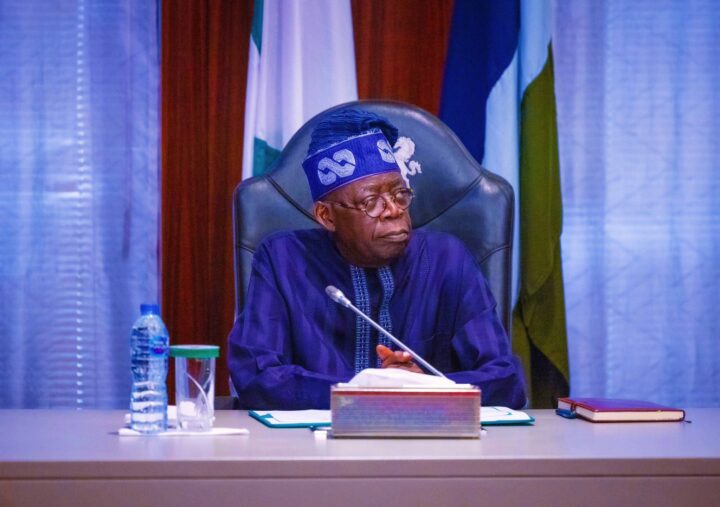
Tinubu Unveils Security Plan, Targets 28,000 New Soldiers
The APC campaign council says the President is also pursuing a five-year defence strategy, but the 50,000-police recruitment and 28,000-soldier expansion had been announced previously
Meta Description: Tinubu security plan includes 28,000 additional soldiers, four Army divisions and expanded training facilities as Nigeria battles insecurity.
Also read: Tinubu Aide Rejects Reports of Convoy Attack in Abuja
President Bola Tinubu’s administration has outlined plans to strengthen Nigeria’s security architecture through the recruitment of 28,000 additional soldiers, an expanded military structure and a proposed five-year defence strategy aimed at tackling terrorism, banditry and kidnapping.
The All Progressives Congress (APC) Presidential Campaign Council disclosed the measures in a statement issued on Sunday, November 15, 2026, by its spokesperson, Dele Alake.
The council said the proposed Five-Year Strategic Defence Operations Plan would provide a long-term framework for improving military effectiveness, expanding operational capacity and aligning defence priorities, equipment requirements and expenditure with the country’s security challenges.
It also said Tinubu had approved the recruitment of 50,000 police officers to strengthen internal security and improve the response to criminal activities.
However, the police recruitment figure is not an entirely new approval. Tinubu announced in November 2025 that the police would recruit an additional 20,000 officers, bringing the planned intake to 50,000.
The Police Service Commission subsequently opened the recruitment exercise in December 2025 and handed over the list of 50,000 successful candidates to the Nigeria Police Force for training in August 2026.
Similarly, the recruitment of 28,000 additional soldiers had been announced by the Nigerian Army in June, while Tinubu’s approval for expanding the Army from eight to 12 divisions was reported in July.
The APC council said the administration had established four new Army divisions and restructured existing formations to expand operational coverage and improve responses to security threats.
It also disclosed plans to establish two additional Army recruitment and training depots in Osogbo, Osun State, and Amasiri-Edda, Ebonyi State.
According to the statement, each facility can accommodate 6,000 recruits at a time, providing a combined training capacity of 12,000 soldiers.
The council added that 5,210 recruits were already undergoing training at the Osogbo facility, while the additional infrastructure was expected to accelerate recruitment and improve the availability of trained personnel.
On military accommodation, it highlighted a 700-unit barracks project in Ikere-Ekiti, Ekiti State, as part of efforts to improve personnel welfare and provide operational support.
The council also claimed that military operations across the country had eliminated more than 15,000 Boko Haram terrorists and bandits in the last three years.
It further claimed that more than 130,000 Boko Haram fighters and their dependants had surrendered through Operation Safe Corridor, the Federal Government’s rehabilitation and reintegration programme for repentant insurgents.
The figures were presented by the campaign council as evidence of the administration’s military and non-military efforts against insecurity.
However, the council did not provide a breakdown of the reported casualties or surrender figures in its statement.
The proposed five-year strategy is expected to build on an earlier presidential directive issued in August 2026, when Tinubu ordered the preparation of a comprehensive National Threat Assessment and a rolling Strategic Defence Operations Plan.
The President constituted an 11-member committee, coordinated by his Special Adviser on Homeland Security, Major General Adeyinka A. Famadewa, to develop the framework.
The committee includes the National Security Adviser, Nuhu Ribadu; Minister of Defence, Christopher Musa; Chief of Defence Staff, General Olufemi Oluyede; and the service chiefs, alongside the heads of the Department of State Services and National Intelligence Agency.
According to the State House announcement, the committee was expected to submit the threat assessment and defence plan to the President for consideration and approval within 90 days.
The framework is intended to identify Nigeria’s principal security threats, establish operational priorities, determine capability gaps and guide defence spending and procurement.
The APC council said the strategy would promote a more coordinated, intelligence-led, technology-enabled and prevention-oriented approach to addressing insecurity.
Also read: Tinubu Launches ₦52,500 Minimum Pension for 173,209 Retirees
It maintained that improved manpower, military equipment, intelligence gathering, training and non-kinetic interventions would strengthen the country’s ability to protect lives and property.




Pingback: Tinubu Grants Clemency to 78 Suspects Over Abuja Convoy Attack – FreshUpdates News