

Trump, Putin, Xi Plan Historic Nuclear Talks
The three leaders are expected to discuss nuclear arms reduction and the Iran war at an unprecedented trilateral meeting in China, while leaving Ukraine off the agenda
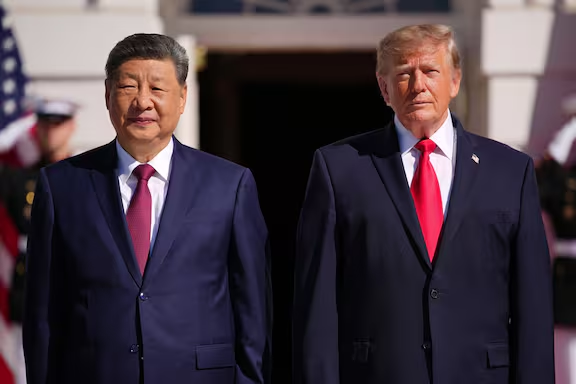
US President Donald Trump, Russian President Vladimir Putin and Chinese President Xi Jinping are expected to hold an unprecedented trilateral meeting in Shenzhen, China, on Thursday, November 19, 2026, to discuss nuclear weapons reduction, the Iran war and other global security concerns.
Also read: Trump Admits Deportation Policy Was ‘Too Tough’ After Midterm Losses
The White House confirmed the planned meeting on Friday, November 13, saying the three leaders would meet on the sidelines of the Asia-Pacific Economic Cooperation (APEC) summit scheduled to take place in the southern Chinese city.
The proposed gathering will mark the first three-way meeting involving the leaders of the United States, Russia and China, three of the world’s most influential military and nuclear powers.
White House Assistant Press Secretary Olivia Wales said Trump intended to use the meeting to push for a reduction in global nuclear arsenals, describing the proliferation of nuclear weapons as a serious international concern.
“The president has made it clear that, among other topics, he will discuss the reduction of nuclear weapons in the world. This proliferation, President Trump believes, is very dangerous,” Wales said.
A senior US administration official also confirmed that the war in Iran would feature in the discussions, although Washington does not expect an immediate agreement to emerge from the meeting.
“I think the president does intend to talk about Iran in the trilateral meeting with Xi Jinping and Vladimir Putin,” the official told reporters during a briefing.
However, Russia’s ongoing war in Ukraine is not expected to feature in the discussions.
According to the official, Washington is pursuing a separate diplomatic process involving Moscow and Kyiv, making China’s participation in the proposed trilateral discussions on Ukraine unnecessary at this stage.
The official explained that the United States had a “whole other track” of negotiations with Russia and Ukraine aimed at finding a way to end the conflict.
The distinction is significant because Ukrainian President Volodymyr Zelensky has repeatedly expressed concern about international negotiations that could determine his country’s future without its direct participation.
The Shenzhen meeting has already attracted comparisons with the historic Yalta Conference of February 1945, when US President Franklin D. Roosevelt, British Prime Minister Winston Churchill and Soviet leader Joseph Stalin met to discuss the post-Second World War settlement.
The conference helped shape the post-war political and territorial arrangements in Europe, including plans for the occupation of Germany.
Zelensky has warned that the proposed meeting between Trump, Putin and Xi could become a modern-day version of Yalta, raising fears of powerful countries negotiating spheres of influence without adequately considering the interests of smaller nations.
The comparison has also generated questions about the implications of closer engagement between Washington, Moscow and Beijing at a time of continuing international conflicts.
Kremlin spokesman Dmitry Peskov, however, has played down suggestions that the Shenzhen meeting could produce an arrangement imposed on other countries.
He described the gathering as significant but stressed that any emerging global order should be based on mutual benefit and respect rather than the imposition of one country’s preferences on others.
Meanwhile, nuclear disarmament is expected to be one of the most challenging issues facing the three leaders.
The last remaining nuclear arms control agreement between the United States and Russia, known as the New Strategic Arms Reduction Treaty (New START), expired in February 2026.
Its expiration removed the treaty’s restrictions on the strategic nuclear arsenals of the two countries for the first time in more than five decades.
Trump subsequently rejected Russia’s proposal to extend the agreement for another year, arguing instead for a new arrangement that would also involve China.
However, Beijing has shown little enthusiasm for joining a nuclear arms control framework with Washington and Moscow, partly because its nuclear arsenal remains considerably smaller than those of the two countries.
Estimates cited by the Associated Press put China’s nuclear stockpile at more than 600 warheads, compared with more than 5,000 each for the United States and Russia.
A senior American official acknowledged the difficulty of securing an agreement but described the proposed gathering as an opportunity to begin meaningful discussions.
The official said Washington did not expect the leaders to announce an agreement at the meeting, describing it instead as an initial conversation that could create room for future negotiations.
Beyond the nuclear question, the gathering also reflects the complicated relationships among the three countries.
China and Russia have strengthened their economic and diplomatic relationship in recent years, particularly since Moscow launched its full-scale invasion of Ukraine in February 2022.
China has become a major buyer of Russian energy resources and an important trading partner, while Moscow has maintained its support for Beijing’s position on Taiwan.
Trump, meanwhile, has sought to maintain direct engagement with both leaders despite disagreements over the Iran war, Ukraine and international security.
The American president is also scheduled to hold a separate bilateral meeting and working lunch with Xi on Thursday. It will be their fourth meeting since Trump returned to the White House in January 2025, according to US officials.
However, no separate one-on-one meeting between Trump and Putin is currently scheduled.
Technology and trade tensions are also expected to remain outside the central discussions.
The White House said the recent controversy surrounding Nvidia chief executive Jensen Huang and allegations involving a Chinese national would not feature prominently in Trump’s engagements with Beijing.
US officials also ruled out discussions on American export controls affecting sensitive semiconductor technology, insisting that such restrictions would remain national security decisions made by Washington.
Billionaire businessman Elon Musk, the head of Tesla and SpaceX, is expected to accompany Trump on his China visit but will not participate in the trilateral meeting.
Trump is scheduled to leave Washington on Monday, November 16, for the Philippines, where he will attend the Association of Southeast Asian Nations (ASEAN) summit before travelling to Shenzhen for the APEC gathering.
The meeting will bring together three leaders whose decisions carry considerable implications for global security, trade, energy and international diplomacy.
Although expectations of an immediate breakthrough remain modest, the planned discussions could provide an important opening for dialogue on nuclear weapons and some of the world’s most pressing geopolitical tensions.
Also read: Trump Says US Has Crushed Iran’s Military, Warns of More Strikes
The extent to which the three countries can translate the historic gathering into practical diplomatic progress, however, remains uncertain.




Pingback: VIDEO: Putin’s Nuclear Briefcase Spotted During China Visit – FreshUpdates News
Pingback: Russia Rejects Ceasefire, Insists on Lasting Ukraine Peace – FreshUpdates News