

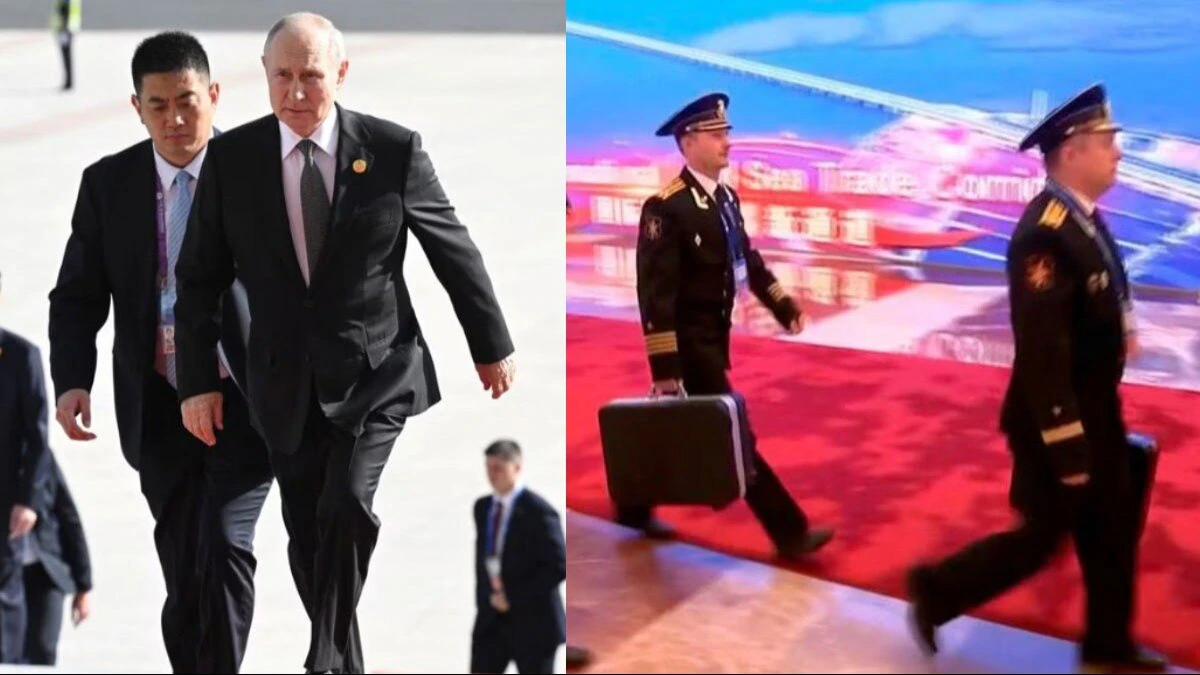
VIDEO: Putin’s Nuclear Briefcase Spotted During China Visit
A Russian naval officer confirmed the identity of the rare Cheget briefcase after it was filmed in Shenzhen, China, ahead of a landmark meeting involving Donald Trump, Xi Jinping and Vladimir Putin
Russian President Vladimir Putin’s nuclear briefcase, known as the Cheget, has made a rare appearance on camera in Shenzhen, China, ahead of a historic trilateral meeting involving United States President Donald Trump and Chinese President Xi Jinping.
Also read: Trump, Putin, Xi Plan Historic Nuclear Talks
The briefcase was spotted on Wednesday, November 18, 2026, as the Russian delegation prepared for engagements surrounding the Asia-Pacific Economic Cooperation (APEC) summit, drawing international attention because of its significance to Russia’s nuclear command and control system.
Footage aired by Russian state television showed a Russian naval officer carrying the black briefcase while accompanying the presidential delegation.
In the video, Russian journalist Yevgeny Popov approached the officer after noticing the case and asked whether it was the country’s famous nuclear briefcase.
“Look, that’s the famous nuclear briefcase right behind us,” the journalist said as the camera focused on the officer and other members of the delegation.
He subsequently approached the uniformed officer and asked, “Hello, is this the nuclear briefcase you’ve got there?”
The officer smiled and replied, “Yes.”
Seeking further confirmation, Popov asked, “Yes? The one?”
“The one,” the officer responded, prompting the journalist to express his surprise by exclaiming, “Unbelievable!”
The footage, which was also circulated by international media outlets, offered an unusual public glimpse of an item that is rarely seen during Putin’s foreign engagements.
The appearance came just hours before the Russian leader was scheduled to participate in a landmark trilateral meeting with Trump and Xi on Thursday, November 19, on the sidelines of the APEC summit.
The meeting represents the first formal three-way summit involving the leaders of the United States, Russia and China, three countries whose decisions have significant implications for international security, global economic stability and nuclear non-proliferation.
According to Kremlin foreign policy aide Yuri Ushakov, the meeting was expected to last approximately one hour, with discussions involving major international security concerns.
The three leaders were expected to address nuclear arms control, the war involving Iran and the continuing conflict between Russia and Ukraine, although the precise scope of the discussions remained subject to diplomatic negotiations.
The briefcase, officially known as the Cheget, forms part of Russia’s nuclear command and control arrangements.
It provides the Russian president with secure communication links to the country’s strategic military leadership and allows the transmission of authorisation relating to nuclear weapons.
Contrary to popular descriptions of it as a nuclear launch button, the Cheget does not independently launch nuclear missiles. It is a communication and command device within a wider military system through which nuclear-use decisions are processed.
The system is named after Mount Cheget in the Caucasus region and is designed to maintain communication between Russia’s political leadership and its strategic military command, regardless of the president’s location.
The briefcase reportedly accompanies Putin during domestic and international trips, although its appearance in publicly circulated footage remains unusual.
The United States also maintains a similar presidential security arrangement known as the Nuclear Football, which accompanies the American president and contains information and communication equipment necessary for nuclear command decisions.
The sighting of Putin’s Cheget has attracted additional attention because of the renewed international debate over nuclear weapons and the future of arms control between the world’s major military powers.
The New Strategic Arms Reduction Treaty (New START), the last major nuclear arms control agreement between Washington and Moscow, expired on February 5, 2026.
The agreement had imposed verifiable limits on the strategic nuclear weapons deployed by the two countries, including restrictions on intercontinental ballistic missiles, submarine-launched ballistic missiles and nuclear-capable heavy bombers.
Its expiration ended more than a decade of legally binding restrictions on the two countries’ strategic nuclear arsenals, raising concerns about the possibility of a renewed arms race.
United Nations Secretary-General António Guterres described the treaty’s expiration as a grave moment for international peace and security, warning that the world was entering a period without binding limits on the strategic nuclear arsenals of the United States and Russia.
China has also maintained that Washington and Moscow should first reduce their substantially larger nuclear stockpiles before Beijing considers participating in formal nuclear arms reduction negotiations.
The issue is expected to feature prominently in the discussions involving Trump, Putin and Xi, particularly as the American president has expressed interest in developing a broader nuclear arms control arrangement that includes China.
Beyond nuclear security, the meeting has attracted attention because of the continuing war in Ukraine and the conflict involving Iran.
Ukraine’s Foreign Minister, Andrii Sybiha, urged Trump and Xi to use their influence over Moscow to pressure Putin into ending the war against Ukraine.
Speaking to journalists in Kyiv on Wednesday, Sybiha said Ukraine expected the discussions to produce pressure on Russia rather than give the Kremlin an opportunity to strengthen its international standing.
“Both the United States and China have decisive influence over Russia, especially when it comes to ending the aggression and bringing the war to a close. We hope and expect that this will be the tone of the conversation, putting pressure on Russia to end the war,” he said.
Sybiha also warned that no decisions concerning Ukraine should be taken without the country’s participation, stressing the importance of protecting its sovereignty and territorial integrity.
Putin, meanwhile, called for greater international cooperation during his remarks at the APEC gathering, arguing that the world needed unity and dialogue rather than growing divisions and confrontational diplomacy.
“What is needed is unity rather than division, and dialogue rather than ultimatums,” the Russian leader said, according to reports of his address.
Chinese President Xi Jinping also expressed optimism about his engagement with Trump, saying he expected meaningful discussions on bilateral relations, regional cooperation and the changing international order.
According to China’s state news agency Xinhua, Xi said he looked forward to an “in-depth exchange of views with you on major issues concerning China-US relations, Asia-Pacific cooperation, and the global landscape, with the aim of advancing a constructive, strategically stable relationship between our two nations.”
The meeting is particularly significant for Putin, who has faced extensive Western diplomatic isolation and economic sanctions following Russia’s full-scale invasion of Ukraine in February 2022.
His appearance alongside Trump and Xi at the APEC summit therefore represents an important diplomatic moment for Moscow as it seeks to strengthen its international relationships and challenge Western pressure.
While the sighting of the Cheget has attracted attention because of its association with Russia’s nuclear arsenal, the broader significance of the Shenzhen gathering lies in the opportunity for the three leaders to address some of the world’s most pressing security and diplomatic challenges.
Also read: Trump, Putin, Xi Plan Historic Nuclear Talks
Whether the historic engagement will produce concrete progress on nuclear arms control, the conflicts in Ukraine and Iran, or broader relations among the three powers remains to be seen.



